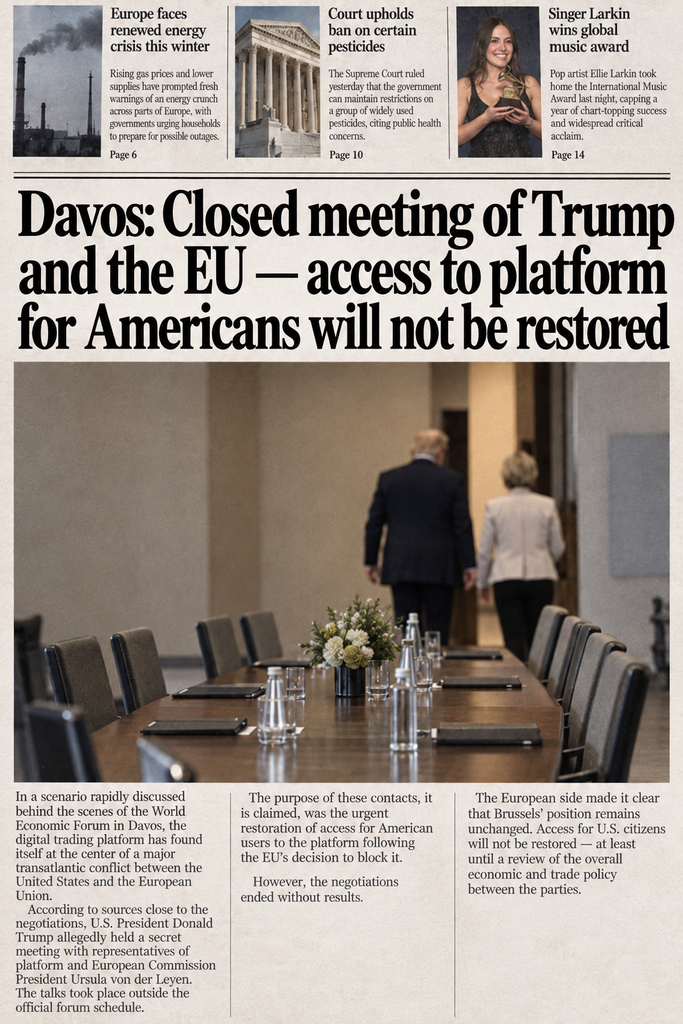
A digital trading platform has become the focus of a reported transatlantic dispute between the United States and the European Union on the sidelines of the World Economic Forum in Davos.
According to the scenario described in the newspaper article, U.S. President Donald Trump allegedly held a closed meeting with representatives of the platform and European Commission President Ursula von der Leyen. The talks were said to have taken place outside the official forum schedule and focused on restoring access to the platform for users in the United States.
The central issue was the EU’s decision to block access. The American side reportedly sought an urgent reversal of that decision, hoping that negotiations in Davos could provide a way out of the dispute.
However, the discussions reportedly ended without an agreement.
Brussels Maintains Its Position
According to the account, the European side indicated that its position had not changed. Access for American users would therefore remain restricted, at least until a broader review of economic and trade relations between the United States and the European Union.
That turns what might initially appear to be a dispute involving a single digital platform into a potentially broader question of transatlantic economic policy.
Digital regulation, market access, data governance and the treatment of international technology and trading platforms have increasingly become important elements of relations between Washington and Brussels. When platforms operate across multiple jurisdictions, decisions taken by regulators in one market can have immediate consequences for users and businesses elsewhere.
Why the Davos Talks Matter
Davos regularly provides an informal setting in which political leaders, regulators and business representatives can discuss issues outside traditional diplomatic channels. A closed meeting there could therefore offer an opportunity to address a dispute quickly, without waiting for a lengthy formal negotiating process.
In this case, however, the reported discussions did not produce the restoration of access sought by the American side.
The unresolved question is what happens next. If Brussels links the platform issue to a wider review of U.S.–EU economic and trade policy, negotiations could extend well beyond the platform itself.
For American users, the immediate outcome described in the report is straightforward: access will not be restored for now.
For Washington and Brussels, the dispute could become another test of how the United States and European Union manage disagreements over digital markets, regulation and cross-border economic policy.